Home
Facebook Page
Members
Gloal Links
.S&T Observing Page
.Heavens Above
.Space Weather
Local Links
.Bruneau Dunes
.Centennial Observatory
.Faulkner Planetarium
|
|
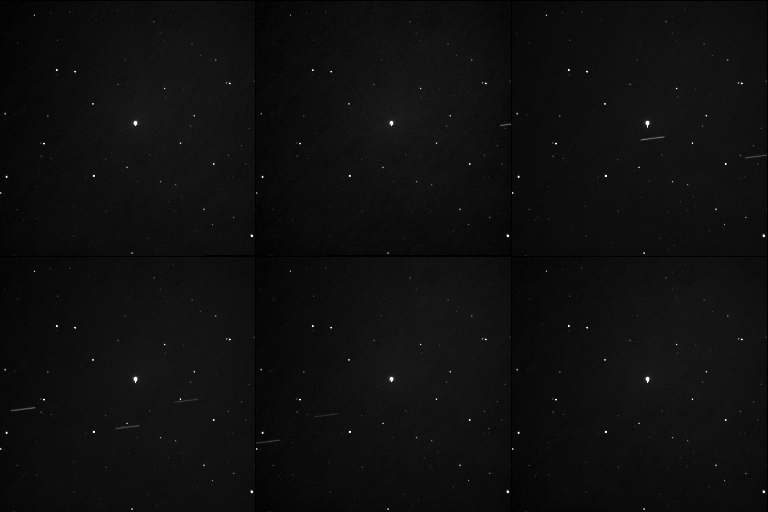
Strange Streaks near Uranus
On October 8th, Jim Tubbs posted this message to the MVAS members list:
I've got my scope out tonight looking at Uranus.
right now the time is abot 9:40. At 9:20, I
observerd an object pass very close to Uranus.
it was moving fairly slow, and I don't believe it
was an airplane. I was observing with a standard
24 mm eyepiece. I didn't count, but it took approx
30 seconds to cross my field of view. I followed
it a bit against the background. I returned to
Uranus a few minutes later, and observed 3 more
objects on same plane pass near Uranus. The stars
in the background are remaining stationary.
Can anyone suggest what I may be seeing?
The next day, Chris Anderson posted this response:
Geosynchronous satellites orbit 22,299 miles above the Earth. Many
(most?) are positioned over the equator, so they are also geostationary
(i.e. they remain "fixed" over a particular spot on the equator,
orbiting Earth exactly once per day). If we were on the equator, we'd
see them on the celestial equator (declination 0d). Since we are north
of the equator, we see them south of the celestial equator. Doing a
little bit of trig, I calculate that a geostationary satellite seen from
Twin Falls should appear at declination -6d 37m.
According to The Sky, Uranus is currently at declination -6d 28m, well
placed for having geostationary satellites pass through its field of
view. I'd bet my eye teeth that you saw geostationary satellites (and
that they passed a bit south of Uranus in the field, moving from west to
east).
Last night (October 11) Ken Thomason, Rick Widmer and John Hall shot a
number of images of Uranus using the Shotwell CCD camera (Apogee Alta
E-47) on the Meade ED-127 'finder' telescope attached to the 24" DFM
telescope. The approximate field of view is 16.5 minutes. Each frame
of this animation is a 15 second exposure. The shots were taken as fast
as possible. The animation deserves a day or two of processing, but I
don't have time right now. We have another set of images to process.
I hope to have an even better video from the second set of images we took for the meeting Saturday. Hope to see you there!
|
 LIVE WEBCAST!
Friday, October 19, 2007 - 7 PM CT
LIVE WEBCAST!
Friday, October 19, 2007 - 7 PM CT
Exploding Stars in an Accelerating Universe
Dr. J. Craig Wheeler, renowned astrophysicist and author, will lead an
exploration of ideas at the cutting edge of current astrophysics. His
extraordinary journey to investigate explosions of supernovae, resulting
neutron stars, mysterious black holes, and elusive gamma ray bursts are far
from science fiction. These exotic objects in our universe make up the life
cycle of stars, are the basis for planets and life, and measure the history
and fate of our Universe. Dr. Wheeler’s lecture follows the
formation of supernovae, their characteristic shape and its significance, as
well as the resulting celestial objects formed by the collapse of a
star. Along the way, Dr. Wheeler examines evidence suggesting that the
Universe is actually accelerating. He also explains recent developments in
understanding gamma-ray bursts - perhaps the most catastrophic cosmic events
of all.
Click here for details
|
Upcoming Events
Astronomy Talk - "Introducing Cepheus, the King" -- Friday, November 16th.
The origins, mythology, and interesting targets of this circumpolar constellation.
Herrett Center - 7:15 PM
MVAS Meeting and Star Party -- Saturday, November 10th.
Annual business meeting. Vote on proposed changes to the bylaws!
The proposed changes can be seen here
Herrett Center - 7:00 PM
|
|
The Eclipse report is here.
|
The Pomerelle Star Party report is here.
|
Look for previous contents of this page
here.
|