
|

|
|
Home Facebook Page Members Gloal Links .S&T Observing Page .Heavens Above .Space Weather Local Links .Bruneau Dunes .Centennial Observatory .Faulkner Planetarium |
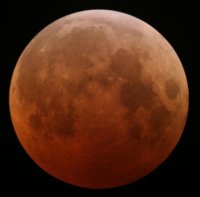 The Herrett Center will have the Centennial Observatory open for a total eclipse of
the Moon on Tuesday night, August 28th until dawn Wednesday morning. The Observatory
will be open between 2:30 AM to 6:30 AM. This event is free!
The Herrett Center will have the Centennial Observatory open for a total eclipse of
the Moon on Tuesday night, August 28th until dawn Wednesday morning. The Observatory
will be open between 2:30 AM to 6:30 AM. This event is free!
You can download a flash movie that simulates the eclipse, and shows the view from Tycho crater on the moon. This is almost a 10MB download! You will need a recent version of the Flash Player to view the movie. (Most computers have this installed.) Download the zip file, then uncompress it into a new folder. Then you can double click on the eclipse.swf file to watch the movie. You are free to make copies and give it to your friends, as long as the content remains unchanged. DOWNLOAD HERE 
Pomerelle 2007
The Pomerelle Star Party started off a little slow, with maybe a dozen people during the solar viewing. Terry Wolford was the first to arrive with his white light and HA telescopes. The second wave, Chris Anderson, David Olsen, Pam Olsen, Ken Thomason and his kids, and Rick Widmer met at the Herrett Center and hauled off quite a load of equipment, including the 18" JMI, the 10" Meade with the HA filter, and one of the baby Questars. We also took the SHARE Stellacam, AC power supply and a small tv monitor that isn't actually part of the system. Chris and Rick had a little adventure on the way up. After missing the right exit, they went on and came in through Malta instead of Declo and Albion. It didn't add too much to the trip, and maybe less than going to the next exit and turning around. [Besides, simply turning around is boring, and I got to see some Idaho roads I've never been on before.] 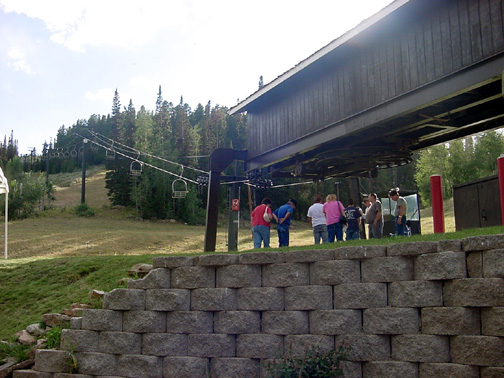
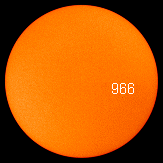 [Image from SpaceWeather.com]
The lack of people for solar viewing wasn't that bad since we had a very
boring sun. There was only one small sunspot, and it was almost
invisible. In HA there was one very dark filament near the
sunspot, and never much more than one nice prominence along the edge.
[Image from SpaceWeather.com]
The lack of people for solar viewing wasn't that bad since we had a very
boring sun. There was only one small sunspot, and it was almost
invisible. In HA there was one very dark filament near the
sunspot, and never much more than one nice prominence along the edge.
Besides some close encounters with cattle, there was a bit of weather related fun, like a big tent getting flipped over by a gust of wind, and worries about rain on the telescopes. Late afternoon clouds are frequent on top of Mt. Harrison, so I wasn't too worried. We broke down the solar viewing equipment, set up for the presentation and had dinner. Sometime between the end of solar viewing and the end of dinner the third wave arrived. Crystal Anderson, Jay and Deb Hartwell, and Forrest Ray. (Can a cup cake be too good?) We moved a few things around since there is no way Jay's van could make it up the "road" we were going to take. 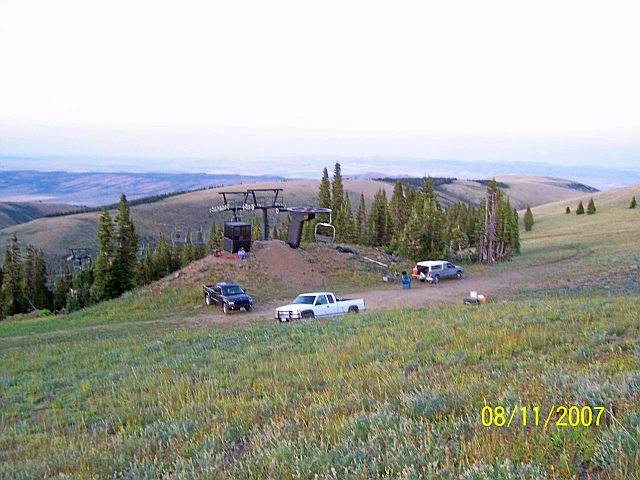 Once we had everything loaded, we started up a service road to the top
of the ski lift. Unfortunately Chris's four wheel drive was acting up
and he was unable to make it up the first part of the hill. Time for a
big change of plans... We went back to the parking lot, and swapped a
lot of equipment around. By the time we were done, there was only about
ten minutes before the talk was scheduled to begin! Hopefully someone
who went up the mountain at this time can fill us in with what happened
until I got up there.
Once we had everything loaded, we started up a service road to the top
of the ski lift. Unfortunately Chris's four wheel drive was acting up
and he was unable to make it up the first part of the hill. Time for a
big change of plans... We went back to the parking lot, and swapped a
lot of equipment around. By the time we were done, there was only about
ten minutes before the talk was scheduled to begin! Hopefully someone
who went up the mountain at this time can fill us in with what happened
until I got up there.
When we first went out to set up the equipment on top of the mountain Starry Night was showing tonight's sky on the projector. When we returned some of the people near the front were talking about what was on the screen, so Rick answered a few questions, then pointed out some of the targets we would be trying for later in the night. [I'm disappointed I missed a chance to point out all the Harry Potter characters that are named after stars and constellations. (Yes, I am a H.P. fan.) There were a few other fans there, but I was good, and handled the astronomy questions.] 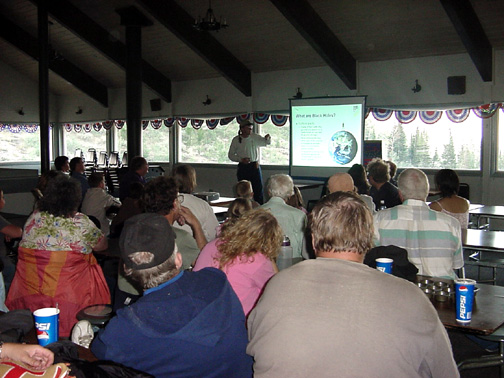 Just before the talk started, Rick showed a Flash movie he is planning
to put on this web site once it is working a little better. It
shows two animations side by side with a clock underneath. The left
side is centered on the moon, as seen from the Herrett Center the
morning of the August 28th. On the right is the view of the Earth and
sun as seen from Tycho crater on the moon. Chris ad-libbed a perfect
plug for the observatory, which will be open that night.
Just before the talk started, Rick showed a Flash movie he is planning
to put on this web site once it is working a little better. It
shows two animations side by side with a clock underneath. The left
side is centered on the moon, as seen from the Herrett Center the
morning of the August 28th. On the right is the view of the Earth and
sun as seen from Tycho crater on the moon. Chris ad-libbed a perfect
plug for the observatory, which will be open that night.
At the beginning of Chris's talk there were thirty eight people. Not bad... The thing is, they just kept coming in. By the end of the talk it was up to fifty eight! WOW! The topic of the talk was "Black Holes, The Weirdest Things in the Universe." It is a layman oriented presentation that answers the questions: 'What are they?', 'Where do they come from?', 'Where are they?' and 'How do we find them?'. Then it points out some black hole weirdness like spaghettification. (Yes, that is a real scientific term! <See Wikipedia.> ) Finally it dispels some myths like black holes are a hazard to Earth. There is only one equation that might give you a headache 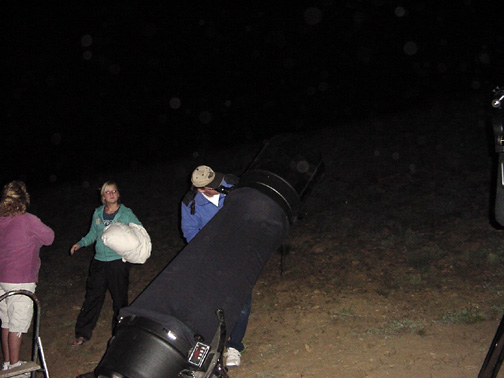 At the end of the talk, we broke down the presentation equipment and
packed it as fast as we could. The driver who was going to take us
up the mountain was also the person who had to be at the top of the
lift before they could let anyone get on it. It was a bumpy, white
knuckle ride up the hill. It was not a lot of fun, but we had a whole
lot of people waiting on us, and I know the driver travels this road
all the time. We did survive, and got the lift started as soon as
we could. We had about twenty minutes before the first people would
arrive.
At the end of the talk, we broke down the presentation equipment and
packed it as fast as we could. The driver who was going to take us
up the mountain was also the person who had to be at the top of the
lift before they could let anyone get on it. It was a bumpy, white
knuckle ride up the hill. It was not a lot of fun, but we had a whole
lot of people waiting on us, and I know the driver travels this road
all the time. We did survive, and got the lift started as soon as
we could. We had about twenty minutes before the first people would
arrive.
David, Pam, Ken and his kids had three telescopes set up, and much of the other equipment already in place when we arrived. That left us with about fifteen minutes to get the 18", 10" and Jay's 12" scopes set up and polar aligned. We did it! The power of team work is amazing. Rick set up the Stellacam on the 10", and getting a picture of Jupiter was pretty easy. That is about all that was easy, though. After wasting too much time trying to find objects and get them focused, he shut the monitor down, and put in an eyepiece. After that he showed Jupiter, M4, M57, and my favorite - M81 and M82 in a single field. It took the SHARE 40MM Teleview eyepiece, but there it was! Chris Anderson kept the 18" JMI scope on M13 early on when we had the biggest crowd, then once the lines died down. M27, M8, M17, Garnet Star, M11, M31/M32/M110, and the Double Cluster. David Olsen put the Questar scope on Jupiter, and kept it there all night. He also did a lot of running around passing messages, and even helped find the parents of a lost child. <<add to list of other items observed here>> The sky was awesome! M13 was visible naked eye, and M31 jumped right out at you, even early in the evening when it was fairly low. I did not see as many Perseid meteors as I expected, but the ones I did see were bright. The most impressive things to me were the inly black sky, either looking overhead, or through the telescopes, and looking off to the west and seeing the valley, its lights, and all the haze that we were above. We had a pretty bright light at the top of the lift, and a noisy generator powering it. Next year that should change. David has a 12 volt light that will do the job running off of a silent battery. Even better, he has a red filter for it. We will probably also move the telescopes further from the top of the lift. There are lots of things to think about before next year. About midnight the crowd was dying down, and we started sending people down the lift, and tearing down the telescopes. The trip down the mountain was much more enjoyable than when I came up. David had this to say about the route, "I had no problems and found the route a typical 2 track 4x4 trail. It wasn't until we came back down that Pam and I noticed we were actually on a skier's dream, or nightmare, depending on your ability, a Black Diamond run. In a previous life I have skied on some Black Diamond runs, but thought I would never actually drive on one." At the bottom we moved equipment around and headed for home. We made it back to the Herrett Center and unloaded the equipment before 3:00 AM. The final count, 132 lift tickes, plus a few season pass holders, and an unknown number of children under 7 who were free and not counted. We had people from as far away as Ogden, Utah. All in all it was a wonderful night, and I am looking forward to next year! Special thanks to: Deb Hartwell who made the idea possible, and was patient enough to see the idea actually take place. It is sad we took several years to finally do it, but this year we pulled it off, and it was much better than we expected. Terry Wofford who kept the idea alive and made it happen. He also sacrificed the night observing to return to the Herrett Center to operate the telescope. Jody Burroughs and the staff at Pomerelle for their wonderful support, and letting us have the event there. Chris Anderson and The Herrett Center for providing a wonderful presentation and telescopes for the event. Images by Deb Hartwell and Pam Olsen. Look for previous contents of this page here. |